
The forecast today was for winds at 35 kph and swells to 2.5 meters, so we opted for a leisurely walk along the beach.
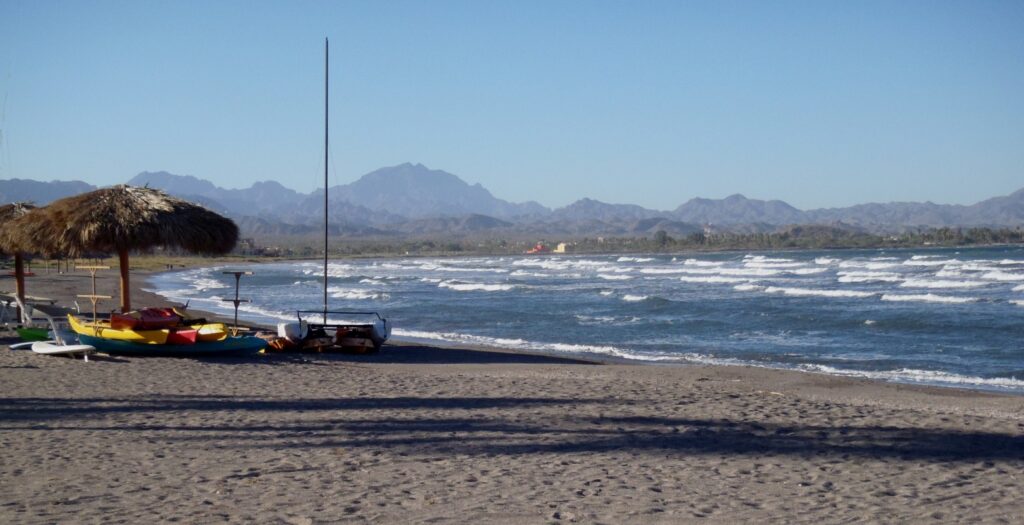
It’s been breezy for a week or more, except for one day when we paddled down to the Vista al Mar. But this afternoon promised to be spectacular visually, so we decided to admire it from a distance. There was even surf in the lagoon!
Las Olas
Posted in Uncategorized
Comments Off on Las Olas
Rays again
We got to the beach just too late to see the dolphins, but we paddled south in their direction anyway, having no other goal. Sea and sky were placid and I took pictures of some schools of fish to try out the new camera. We were most of the way to Notrí and thinking of turning back when Alex spotted the commotion, apparently between Danzante and Puerto Escondido, big creatures jumping well clear of the water and splashing back down audibly — and heading in our direction. They didn’t seem like the dolphins though, there were just a few, at least three, maybe four visible at once. I was trying to get the salt water off the camera lens, ready to take pictures in the air again, but before I finished they were past us. They were closer than they looked because they were smaller than we imagined — big rays though, this time probably sting rays, not like the devil ray we watched in June. It was amazing how long they seemed to stay in the air. It really does look like they’re flying. It must seem like that to them too — they keep flapping their wings as they slice through the air.
Posted in Uncategorized
Comments Off on Rays again
La Salinita
We paddled a bit yesterday for the first time in a couple of months, having been away for part of the summer. The day was mild and it was calm in the morning, so we set out toward the north just after ten o’clock. The wind didn’t come up until nearly two, and by then we had spent a little time afloat with our new waterproof camera.
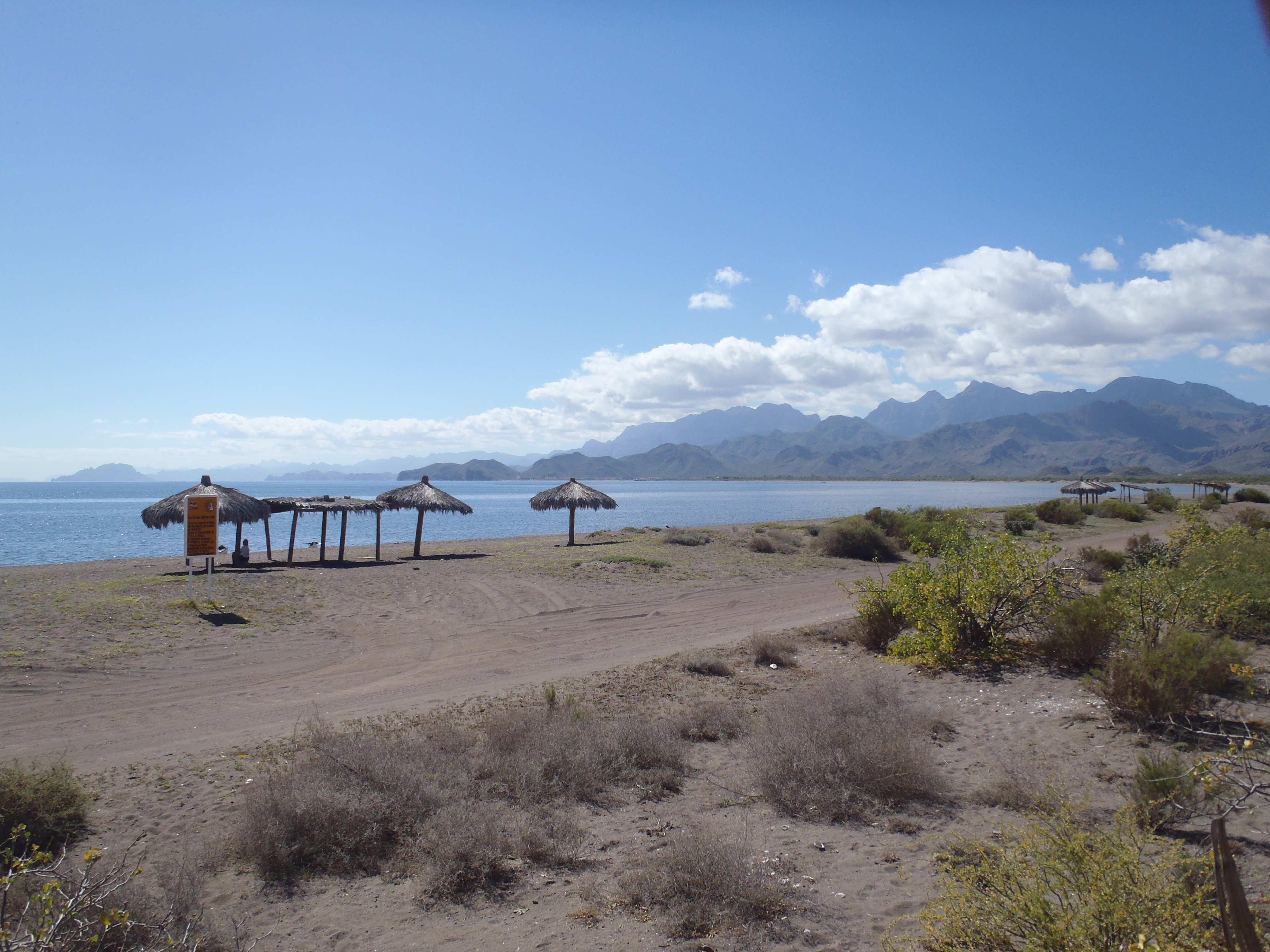
From Loreto’s big arroyo south for miles, the coastline is beachy. The international airport occupies a large portion of this flat area, but starting near the southeast corner of the airport there is a long string of shelters, beginning with three distinct clumps of palapas. The center of these clumps, where the accompanying photo was taken, has a pit toilet just across the road. I suspect that the rectangular shelters further south were built earlier: there is a toilet vault there which has been sealed.
These are not the most picturesque beaches in the area and are not popular campsites for kayaks, but they see a lot of day use, not surprising since they are accessible from town. We see them as often by bicycle as by boat. The road becomes impassible, depending on the tide and your mood, before or after the last shelter — inland “shortcuts” connect all the way to the arroyo just north of Nopoló however, and some lead out to the highway.
Heat Lightning
Last night just as we were getting ready to turn out the light to go to sleep, Alex called me outside to see the eastern sky lighted up. On the other side of Isla del Carmen, and for most of its length, lightning flashed continuously — that is, before a strike dissipated a new one began at another spot. We climbed to our roof and watched for a while, and then went downstairs to look at the big orange blob on the weather map. The mainland, from Guaymas to Guamuchi, was getting a pounding. Our view was filtered by clouds and it was a long ways off — we never heard any thunder despite the obvious violence of the storm.
For us it meant wind and we were glad of that for the time being, because the regular Loreto breeze had weeks before stopped being good for much except shifting dust around. We had begun to sleep downstairs, started using ceiling fans all the time, and gradually become less formal in our attire (clothing being a nuisance because first insulating and then ultimately a problem even to remove, requiring a wetsuit technique no matter what its composition or intended fit). We brought some things inside that we thought might later be blown around, shut some doors, propped some others open, and went to bed.
We’ll know better next time which items are likely to make noise; we ended up with most doors and windows tightly latched. The result was a kitchen even warmer in the morning than usual. It’s been hot! Overnight lows in the 90s (F) mean that no amount of ventilation does much good.
Except for detaching some of our bougainvilleas (as high now as our second-floor pergola) the storm did no apparent damage. It also left no moisture here, but there’s probably some on the way.
Posted in Uncategorized
Comments Off on Heat Lightning
Frigate Birds
Last Sunday Alex stayed home but I thought that I might go and see if it be possible to get one of the kayaks to the beach single-handed and then put it away again. The answer is “probably,” though it is difficult to keep passers-by from helping. Next time I think I may try the lower of the two boats — harder to doff and don the cover, but easier to get the boat back into the rack.
Having gone to this much trouble I saw that a little paddling was in order, so I nudged the boat into the afternoon chop and headed around the point. As I entered the outer lagoon a magnificent frigate bird flew nearly overhead, maybe eight feet above. It banked left, dipped its beak three times in the space of about twenty yards, then continued left to head back the way it had come, passing me again at low altitude.
Now it’s not unusual hereabouts to see a frigate bird, or at least not rare — they tend to spend their afternoons circling above the lake at the golf course. But like many of the other locals they seem to have a lot of time on their hands, and I have seldom seen them actually feeding. Lots of other interesting things they do for sure. I have seen one descend steeply in what must be a deep stall, tail down, little forward motion, and they’re famous for a dive with fluttering wings. Maybe these maneuvers are social somehow; they can’t be intended to scare the fish.
I described the bird as magnificent, but that’s part of its name — to distinguish it from the merely “great” frigatebird, which has a wingspan of only, yes only, seven feet. These guys are large, and this had escaped my notice only because we don’t usually see them up close. They are sea birds, but they don’t swim; what little perching they do is done inland.
Many of the birds here are easy to cozy up to. Pelicans tolerate kayakers and nearly trust snorkelers; cormorants, though nervous, often don’t bother flying away; herons and egrets will pretty much go on about their business unless they feel they are being stalked; you can walk right up to a vulture; gulls will walk right up to you, if you’re near the snack bar. But frigate birds, well, not being a golfer, I had never seen one this close.
Posted in Uncategorized
Comments Off on Frigate Birds
El Regreso
Like I said, conditions were fine for our rest stop, and as we slid back into the water to head for home the breeze seemed quite refreshing. The water had some texture now but was still quite clear and we were making fairly good time. Gradually the waves began to demand attention, and Alex remarked that she could see whitecaps. They never got to be the scary kind, with spray blown off the top, and they weren’t really numerous, either. It was more glistening than menacing, but the waves did get bigger and bigger and they weren’t coming from a very convenient direction, either. Then, as often seems to happen, near the mouth of the arroyo, the water seemed to calm a bit — I considered mentioning it. Then slowly, as often happens next, the waves got bigger again, the wind became quite strong, and we were struggling, not so much to keep upright, but certainly to keep pointed in the right direction. Skegs didn’t seem to help. I don’t think we ever saw waves as high as a meter, but they were close together and a bit confused. Alex, ahead and to my left, looked back to ask if I was okay. I said that I was but was thinking of veering a bit toward shore, in case there was some shelter afforded by the point — or in case I found it convenient at some point to swim. She in fact turned in behind me, and we persevered for a time. I remember at least once looking back and seeing her, but not her boat — this was no longer the day we had chosen.
Alex was the first to notice that we weren’t actually getting anywhere, and I saw her turn to get following waves to take her boat to shore. I was not disposed to leave her — or to keep paddling, for that matter — so I aimed for her spot on the beach. We were back to Loreto Bay now — just not to our end of it — and before us was a nice patch of sand that we sometimes walk along.
Neither of us made it all the way without capsizing. Alex at least had her feet out for landing before she was swamped. I got turned sideways in a couple feet of water and shortly was groping the sand. We were glad to stop paddling for a bit.
Reconnaissance assured us that just beyond the dunes lay the golf course. After some careful planning Alex began organizing our gear while I set off for home on foot. I was there in twenty minutes and quickly found the racks for the car top. It was only about three quarters of an hour after leaving her that I sighted Alex again, down at the end of the road that leads past the two new Homex model units. We got the cross-bars and then the boats themselves atop the car, and then spent a long time trying to remember the clever ways we had invented eight months earlier to fasten down our load. Our car has its own web page, by the way; see http://www.mwenda.com/Snowball .
We were soon back home, then showered and drying out. Sometime before sunset the wind died down a bit, suggesting that if we had waited long enough we could have completed our journey without the “auto” rescue. Sometimes we are equipped to risk an unexpected night out, but in this case it didn’t seem to make much sense. We are glad that our fairly urban surroundings make it possible to have adventures like this, especially considering the wildlife we met on our trip, without usually having too much at stake.
Posted in Uncategorized
Comments Off on El Regreso
Los Tiburones
The forecast was good for today and we had a nice early start. Walking down to the beach with our gear we saw Chaly talking to somebody and when we caught up to him he asked us if we could see the shark. Sure enough, there was something like a fin fifty meters off shore. Chaly said that he had already been out in the red canoe for a look.
It took half an hour for our boats to get freed up and down to the shore but we set off in what we guessed was the right direction, and it wasn’t long before I saw fins circling. The biggest fin seemed disappointingly rounded, but there were plenty of them. They seemed to be moving in opposite directions but I realized that there was only one fish circling, just a very long one. Alex had joined me by now and the shark, keeping some distance, swam in an arc across our bows and then headed back as to strike Alex amidships. I was starting to get a little concerned, and probably she was too. There was nothing threatening about the creature’s manner, but its length seemed to become more and more significant as the distance diminished. Nearing, it turned slightly to pass behind Alex’s kayak; light-colored spots and considerable width gave away its identity. We knew that it was a whale shark, an example of the world’s largest fish, and someone we had long wanted to meet.
We kept up for a while, admiring the scale of the creature’s grace, trying to stay out of the way without losing sight. Another kayak launched meanwhile, paused to say hello, and then went in for a closer look. We let the pair monopolize our new friend’s company until it remembered a prior engagement and headed back to deeper water.
But by then we had made another discovery. With everyone distracted, another set of smaller fins overtook Alex on her starboard side and turned in front of her. This one had wings! Just four feet wide by my guess, this was a devil ray, from both its expression and its feeding habits, not unlike those of the whale shark. We imagined it to be a manta ray, but they are mostly ocean-going and are much larger except when very young. Thurston’s, or bentfin devil ray is another guess. They breed in the Sea of Cortez in the spring.
Our day was complete, but we had just arrived. We thought we should pick a direction so we headed toward Loreto. We still have Isla Coronados in our sights and have been looking for stopping places along the way. As we passed the disused boat ramp a pair of the local security guards motioned us in to warn us of the shark danger, but we we able to tell them that we had seen the chracters in question and that they were not dangerous. While conversing with them there (taking slightly longer in Spanish) we noticed a dark colored heron standing calmly off to the left, with yellow around its eye but not readiily identifiable with my field guide.
We paddled up to our favorite palapas south of the airport. Our kayaks are now always equipped with camp stools, so we sat in the shade for quite a while and drank canned fruit juice. We thought that we would wait for it to laten up a bit so that we could tell for sure what it would be like to paddle in the heat of the day. By the time we got back into our boats again a breeze from the east had made itself felt. And thus begins the rest of the story of our day.
Posted in Uncategorized
Comments Off on Los Tiburones
Wind Creatures
We may need to become wind creatures as well. We’ve scarcely been paddling since our practice camping trip, spending a lot of time on land instead, biking, puttering in the garden, testing out the hammocks. We have been waiting for the right string of days for an island trip, easy on the heat but light on the wind and waves. The accessibility of forecast information has helped us avoid some disappointments but it may also have kept us home on some days that would have been okay, watching the little red dot that is our current selves, riding up and down the graph of the daily tides, hoping for waves no more than two tenths of a meter, or at least periods greater than four seconds.
We swim anyway, though, feeling that there’s less at stake or that it’s easier to back out. We went down to the beach today, for instance, in 20 kph winds but a tide well above average. There were little gust marks on the surface, clearly audible from below as they moved past. We drifted easily away from the beach but had to work a little when it was time to come back. Water was cold in spots, with shimmering boundaries like heat waves. Didn’t see any new kinds of creatures, but I saw the tiniest pintanos I ever have, maybe an inch long but with all the detail of their larger brothers.
Our last trip out together was six days before, and it was a lot more eventful. We had waded in as usual with the intention of going out toward the point and then returning when tired or cold, but we ended up swimming all the way around and into the lagoon and emerging on the easy beach there. I saw lots of rays of two different kinds, and scissortail damselfish out by the point.. On recent trips we had for the first time met a beautiful zebra moray, and Alex had seen an octopus and a slate pencil urchin that impressed her a lot.
Today I received a reminder from Greenpeace that the International Whaling Commission is meeting in Morocco in coming weeks and considering lifting its ban on commercial whaling. I sent a donation. The next time I meet a whale I want to be able to look it in the eye.
Posted in Uncategorized
Comments Off on Wind Creatures
New Moon
Actually it was some time after the new moon before we got down to the beach again; but even at five in the evening, hours before the high tide, there was still plenty of water above the rocks around the point. We swam, instead of taking the boats out, thinking that this would count as the day’s exercise.
Still on the flood this late in the day, the sea hadn’t been warmed the way it was at Juncalito; and so as usual this time of year one is left wishing for a bit of neoprene — we were in shorts and shirts. The clip that means to hold my snorkel to my mask had broken during a year of careless storage, but I just slipped the tube under the strap and waded in.
Wildlife appeared immediately. Alex, swimming ahead, says that she saw a dozen rays during our half hour or so. I saw only probably the first one, who met me coming in the opposite direction, possibly flushed by her. Its body was the size of a dessert plate and I saw no markings, so I wondered if it could be a young electric ray. Most of the ones we see in deeper water are target-like.
We both also saw a moray eel, but otherwise the cast was much as usual: wrasses, Cortez damselfish, the gregarious pintanos, but in far greater numbers than usual. I got out to towel off and shiver a bit but Alex swam some more. In the summer, when the water and the air are both hot, I may not even bother to bring a towel, but it was welcome today, if only for making the feet ready for the sandals. We walked home and eventually cooked dinner. By eight o’clock it still wasn’t completely dark.
Posted in Uncategorized
Comments Off on New Moon
Juncalito
We finally got around to going camping with our new equipment. We had spent some time sorting things out, waiting for the right conditions, occasionally paddling with guests or just idly floating. But this Thursday we toted a bunch of gear down to the beach, packed our kayaks as never before, and set of for Juncalito, something like six miles to the south.
We had considered using the beach north of our home as our testing ground. We knew that it had palapas and primitive sanitation, and if things went seriously wrong it would have been within something like walking distance. We had also thought about the beaches next to our two favorite restaurants, but Alex wanted cooking to be a serious part of our adventure. More than one person suggested Juncalito, and said that we would probably have the beach to ourselves this time of year. Apparently it is a big gathering place during Semana Santa, but lonelier after the first of May when the heat becomes serious, as indeed it did.
We had tried looking at the little village from the road, but hadn’t gotten past the assortment of houses. From the sea, approaching from the north, the expanse of beach is more obvious. There are four palapas (and five trash cans); we took the spot furthest east, near the point. This is a beach that people drive on, and early in the evening we had a chance to help some people whose truck was stuck in the sand on their way over to the next little cove, where there was a boat moored in the shallows that lead out to the nearby isleta (Mestiza on the map).
By the time we arrived, about three in the afternoon, the water in the shallow bay was already body-temperature and the sand so hot that you couldn’t run on it — or even act casual if it got inside your sandals. We are thinking that for the next few months the limiting factor on kayak travel may be shade, not distance, food or water. I have a vision of a tarp that we could erect using four paddles — or we may try to get a tent with a fly that could be used by itself. I carried two and a half gallons of water by the way, ahead of my feet in the Fathom’s cockpit, and augmented as it was by water bottles, canned drinks and moisture-bearing food it might have lasted us through a second day at the same camp.
Juncalitanos are known to be a fun-loving group and there was music late into the evening, and then some sort of event that had police and soldiers nosing about. I hope that we weren’t trying too hard not to look suspicious. After sunset the sky became clear, and then dark, and then full of stars, and ultimately the Milky Way was visible. You can see the Loreto lighthouse from the middle of the beach, and the sweep of the airport beacon. The moon was at its third quarter and did not rise until I was asleep.
We fried eggs in the morning, proving our ability to transport delicate and somewhat perishable food and to fit enough of it into our new cookware. The camping that we had organized for ourselves in the past had been during backpacking trips, where both weight and size seemed critical. We again have an MSR white-gas stove like the one that I started out with and later gave away — except that this one is a lot quieter. Our cookset is bigger than my old stainless set, and we foresee carrying more pieces at a time. There was plenty of empty space in the boats despite our bringing just about everything we could imagine for one or more days, and they didn’t seem to notice the extra weight much either, except when being moved about on the beach fully loaded.
With another easy day facing us, we arose at our leisure, chatted with some local paddlers out for their morning stroll, and launched at a time calculated to make sure that the Vista al Mar would be open before we could possibly arrive. We first paddled toward town to see if we could spot our new friends, and then, at Alex’s suggestion, out to and around the little island. We saw a lot of fish, and then, just at the end of the shallowest bit (Alex backed up once), a pair of neophyte paddlers with questions about equipment. We had plenty of time to linger over lunch and make it back to Nopoló before Chaly left for the day, as he was waiting for a late-afternoon customer to return.
The water was glassy for most of our trip, the biggest swells being from the wake of a cabin cruiser that passed well outside of us. We saw a lot of fellow sea life, including a sea lion or two, several rays, and big groups of yard-long fish hunting near the surface, their arcing fins cutting the water like sharks in the cartoons. Our new friend from Juncalito was out fishing in his kayak the last time we saw him, and he was looking for roosterfish, so maybe that’s what these are.
Posted in Uncategorized
Comments Off on Juncalito